
How to Paint Shadows and Lights: Warm vs Cool Colors and Transparent vs Opaque Oil Paints

Updated: Sep 21
Painting convincing and believable shadows and highlights is... well, not always easy. Sometimes it can be down right maddening. Today we are going to take a deep breathe and review the four rules of the shadow and highlight relationship. Knowing these qualities and how they work together can help us solve some of our problems. These rules are:
Tonal Shift
Temperature Shift
Opacity Shift
Detail vs Blocked Colors
We are going to use the paintings “Study of Lilia" by Carolus-Duran and "Cakes" by Wayne Thiebaud to show us how we can use these rules to our advantage.


Tonal Shift

A tonal shift is merely moving from light to dark. We have done this since we first started shading with our crayons. Sometimes the tonal shift is intense like in Caravaggio's paintings, or very subtle such as in our examples.
Temperature Shift
This is where things start to get a little bit more tricky. It is important to not think of shadows as just being black, gray, or cool blue. Shadows are often warmer than we realize.
Sometimes the difference in color temperature between a light and shadow is so small it is difficult to tell which is which and it does take practice. When considering the temperature of a shadow ask yourself the following questions:
1. Is the light source natural? Daytime light usually has a cool, blue tint to it, making all of the shadows warm.
2. Is the light source artificial? Most artificial lighting is warm. At night, look around your house and notice how cool the shadows are versus during the day.
If the light hitting an object is a warm light, the highlights will be warm and the shadows will be cool. If the light hitting an object is cool, the highlights will be cool and the shadows will be warm.
Let's break down the"Study of Lilia":

Background = Cooler
Carolus-Duran most likely used transparent Alizarin Crimson, which is a cool red.
Foreground / Dress Color = Warmer
Carolus-Duran most likely used opaque Cadmium Red for the base and then mixed Yellow Ochre for the highlights.
Note that both the tonal and temperature shift is very subtle, but it is enough to give the painting dimensionality. He then created uniformity throughout the painting by maintaining the same cool to warm color shifts in the hair and skin.
Now let's break down "Cakes":

Here we can see how Thiebaud uses color temperature to create a believable shadow and highlight relationship. Note how minimal his use of tonal shifts is, and how instead Thiebaud relies heavily on the temperature shift of his colors to create dimensionality.
Temperature shift is why I recommend having a cool and warm for all primary colors as part of my beginner's color palette. You can read more about the colors I recommend here.
Opacity Shift
Opaque paints move forward while transparent paints recede.
In Carolus-Duran's "Study of Lilia" he uses transparent paints for the background and opaque paints for the foreground. This coupled with the shift in tonality and temperature gives him his rounded forms.
In Thiebaud's "Cakes" he uses opaque, opaque, and more opaque paints. However, he does utilize transparent paints in his outlines. Which is where we see his "darkest" and "deepest" colors. But again, Thiebaud leans heavily on color temperature verses tonality and opacity.
The video below explains this in more depth.
Detail vs Blocked colors
The more detail a section has the more your eye is drawn to it. As artists, we need to decide if our highlights or if our shadows will have more detail and therefore more importance. If both are equally detailed our eye will not know where to rest and the painting can look busy and flat.
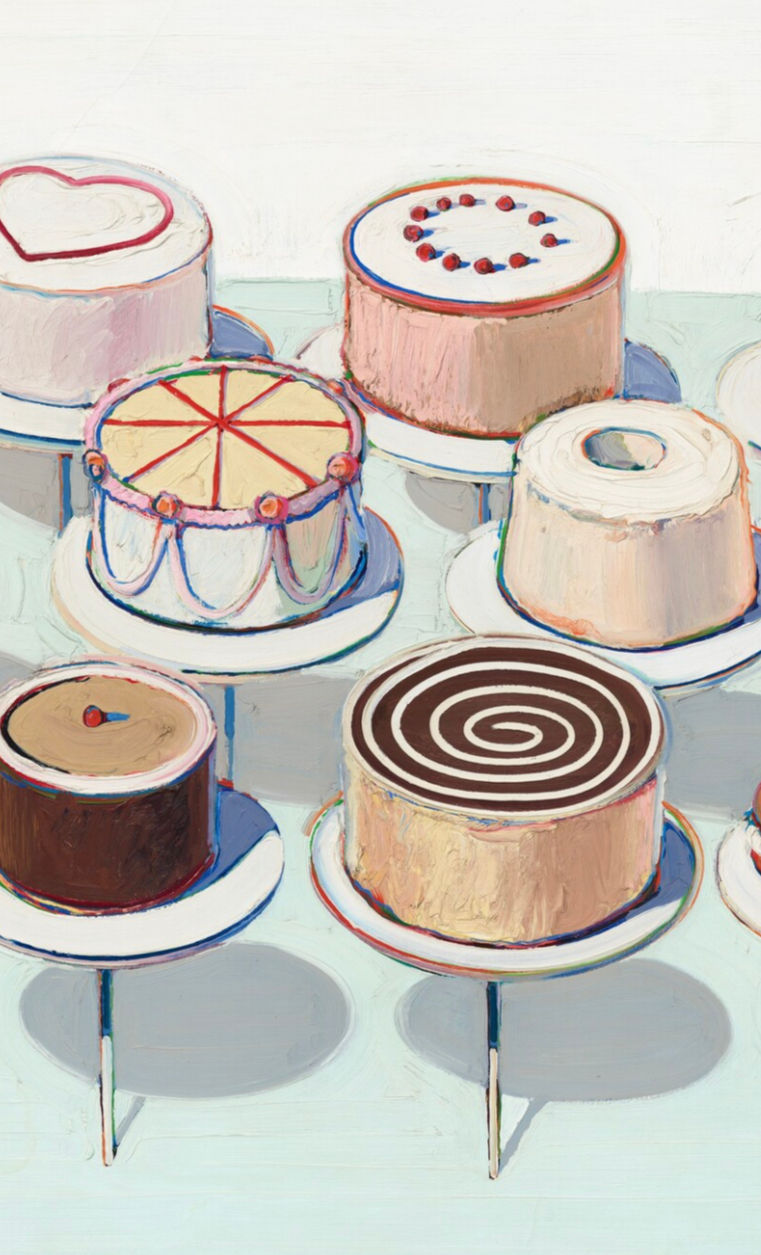
In "Cakes" we can see a lot of texture detail in the highlights. The building up of Thiebaud's paint draws our eyes to these areas, where as his shadows have less.
In "Study of Lilia," Carolus-Duran keeps the shadows relatively flat, whereas the highlights of the hair, skin, and ear have more details and therefore, again, draw our eyes.
Conclusion
Understanding the relationships of tonality, temperature, opacity, and detail will aid us in creating the types of painting we want to paint.
In a future post I will be breaking down the elements of a shadow and how using ambient light and complimentary colors can trick the eye into seeing depth. Which is where Thiebaud shines.
What do you think? Did I miss anything?
If you would like to keep up with future posts, follow the link below to subscribe to my monthly newsletter:
And I hope you are having a great day!


Can it be done with only 1 of the qualities/shifts? It seems that you don't NEED all 4, at least. Do most paintings use all 4, or can you focus on just a couple?